Showing posts with label atomic radius. Show all posts

Saturday, September 29, 2012

PAULING ELECTRONEGATIVITY VALUES

An atom's electronegativity is affected by both its atomic number. Linus Pauling's electronegativity scale is the most common. First proposed by Linus Pauling in 1932. According to the great Linus Pauling, electronegativity is “the power of an atom in a molecule to attract electrons to itself. Linus Pauling's Development of an Electronegativity Scale. The modern definition of electronegativity is due to Linus Pauling. The first scale of electronegativity was developed by Linus Pauling and on his scale boron has a value of 2.04 on a scale running from from about 0.7. Electronegativity is measured on a variety of scales, the most common being the Pauling scale.  Perhaps the most popular method of determining electronegativity is through Linus Pauling (1901-1995)'s model. The concept of electronegativity was put on a quantitative footing in 1932 by Linus Pauling in The Nature of the Chemical Bond. The higher the associated electronegativity number, the more an element or compound attracts electrons towards it. Linus Carl Pauling is the only person to have received two unshared Nobel Prizes - first in 1954 in chemistry. Besides being the greatest architect of chemistry, Pauling was a founder of molecular biology and a pioneer in quantum mechanics. Pauling combined chemistry and physics to solve various puzzles related to the nature of chemical bond. As one of his biographers has written Pauling's understanding of the chemical bond and molecular architecture is probably unsurpassed in the history of chemistry.
An atom's electronegativity is affected by both its atomic number. Linus Pauling's electronegativity scale is the most common. First proposed by Linus Pauling in 1932. According to the great Linus Pauling, electronegativity is “the power of an atom in a molecule to attract electrons to itself. Linus Pauling's Development of an Electronegativity Scale. The modern definition of electronegativity is due to Linus Pauling. The first scale of electronegativity was developed by Linus Pauling and on his scale boron has a value of 2.04 on a scale running from from about 0.7. Electronegativity is measured on a variety of scales, the most common being the Pauling scale.  Perhaps the most popular method of determining electronegativity is through Linus Pauling (1901-1995)'s model. The concept of electronegativity was put on a quantitative footing in 1932 by Linus Pauling in The Nature of the Chemical Bond. The higher the associated electronegativity number, the more an element or compound attracts electrons towards it. Linus Carl Pauling is the only person to have received two unshared Nobel Prizes - first in 1954 in chemistry. Besides being the greatest architect of chemistry, Pauling was a founder of molecular biology and a pioneer in quantum mechanics. Pauling combined chemistry and physics to solve various puzzles related to the nature of chemical bond. As one of his biographers has written Pauling's understanding of the chemical bond and molecular architecture is probably unsurpassed in the history of chemistry.  

Friday, September 28, 2012

IONIZATION ENERGY PERIODIC TABLE
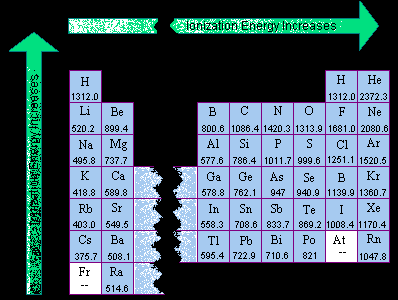
Veiw a periodic table with first ionization energies. Chemical elements listed by ionization energy. The elements of the periodic table sorted by ionization energy. List of Periodic Table Elements Sorted by Atomic Number ..... Ionization energy The elements of the periodic table sorted by ionization energy The Periodic Table of the Elements (with Ionization Energies) This graph displays the periodic trend of ionization energy versus atomic number. Here's more information about what ionization energy is and what trends in ionization energy  Ionization Energy - Ionization Energy of the Elements Thus the ionization energy of the elements decreases as you go down the periodic table because it is easier to remove the electrons. First ionisation energy - WebElements. IONISATION ENERGY. This page explains what first ionisation energy is, and then looks at the way it varies around the Periodic TableIonization Energy - Periodic Trends Why does the ionization energy increase as you go left to right down the periodic table what happens to the ionization energy What are the ionization energy trends seen in the periodic table The trend in effective nuclear charge accounts for the increase in ionization energy across a period.
Veiw a periodic table with first ionization energies. Chemical elements listed by ionization energy. The elements of the periodic table sorted by ionization energy. List of Periodic Table Elements Sorted by Atomic Number ..... Ionization energy The elements of the periodic table sorted by ionization energy The Periodic Table of the Elements (with Ionization Energies) This graph displays the periodic trend of ionization energy versus atomic number. Here's more information about what ionization energy is and what trends in ionization energy  Ionization Energy - Ionization Energy of the Elements Thus the ionization energy of the elements decreases as you go down the periodic table because it is easier to remove the electrons. First ionisation energy - WebElements. IONISATION ENERGY. This page explains what first ionisation energy is, and then looks at the way it varies around the Periodic TableIonization Energy - Periodic Trends Why does the ionization energy increase as you go left to right down the periodic table what happens to the ionization energy What are the ionization energy trends seen in the periodic table The trend in effective nuclear charge accounts for the increase in ionization energy across a period. 

Saturday, September 22, 2012

HIGHEST ELECTRONEGATIVITY

The elements with the highest electronegativity are found in the upper right corner of the periodic table, excluding the noble gases.Electronegativity increases as you go from left to right across a period. Elements on the left of the period table have 1 -2 valence electrons. Electronegativity values generally increase from left to right within the Periodic Table of the elements. the relatively low-level quantities of bond lengths, electronegativities, and position in the periodic table. oxygen is more electronegative than chlorine. In the periodic table as we go to the right the size decreases so the electronegativity increases. Fluorine is the most electronegative element and caesium is the least electronegative atom. within metals electronegativity is high for metals at the top of the periodic table since they are small/dense and therfore have small radius. Electronegativity is how badly a element wants to a electron, F is the most electronegative element on the periodic table. periodic table, an atom's electronegativity is affected by both its atomic weight and the distance that its valence. Electronegativity generally increases as you move from left to right. This is because ionization energy steadily increases.
The elements with the highest electronegativity are found in the upper right corner of the periodic table, excluding the noble gases.Electronegativity increases as you go from left to right across a period. Elements on the left of the period table have 1 -2 valence electrons. Electronegativity values generally increase from left to right within the Periodic Table of the elements. the relatively low-level quantities of bond lengths, electronegativities, and position in the periodic table. oxygen is more electronegative than chlorine. In the periodic table as we go to the right the size decreases so the electronegativity increases. Fluorine is the most electronegative element and caesium is the least electronegative atom. within metals electronegativity is high for metals at the top of the periodic table since they are small/dense and therfore have small radius. Electronegativity is how badly a element wants to a electron, F is the most electronegative element on the periodic table. periodic table, an atom's electronegativity is affected by both its atomic weight and the distance that its valence. Electronegativity generally increases as you move from left to right. This is because ionization energy steadily increases. 

Thursday, September 20, 2012

Periodic Table Trends

Summary of Periodic Table Trends. Moving Left  Right Atomic Radius Decreases Ionization Energy Increases Electronegativity Increases. Periodic table of electronegativity using the Pauling scale → Atomic radius ... molecule to attract electrons to itself. Electronegativity, metallic nature and atomic radius. ... Groups of the Periodic Table; Valence Electrons; Periodic Table Trends: Ionization Energy. Patterns of electronegativity in the Periodic Table. Electronegativity is a measure of an atom's "pull" on electrons. It is affected by the distance from the nucleus, electron-electron charge repulsion. Trends in Electronegativity in Periods of the Periodic Table In general, electronegativities of the elements in the same Period increases as you go from left to right. Electronegativity is a measure of the tendency of an atom to attract a bonding pair of electrons.The Pauling scale is the most commonly used. Fluorine (the most electronegative element) is assigned a value of 4.0, and values range down to caesium and francium which are the least electronegative at 0.7.  If the atoms are equally electronegative, both have the same tendency to attract the bonding pair of electrons, and so it will be found on average half way between the two atoms. No electronegativity difference between two atoms leads to a pure non-polar covalent bond.A small electronegativity difference leads to a polar covalent bond.A large electronegativity difference leads to an ionic bond.

Summary of Periodic Table Trends. Moving Left  Right Atomic Radius Decreases Ionization Energy Increases Electronegativity Increases. Periodic table of electronegativity using the Pauling scale → Atomic radius ... molecule to attract electrons to itself. Electronegativity, metallic nature and atomic radius. ... Groups of the Periodic Table; Valence Electrons; Periodic Table Trends: Ionization Energy. Patterns of electronegativity in the Periodic Table. Electronegativity is a measure of an atom's "pull" on electrons. It is affected by the distance from the nucleus, electron-electron charge repulsion. Trends in Electronegativity in Periods of the Periodic Table In general, electronegativities of the elements in the same Period increases as you go from left to right. Electronegativity is a measure of the tendency of an atom to attract a bonding pair of electrons.The Pauling scale is the most commonly used. Fluorine (the most electronegative element) is assigned a value of 4.0, and values range down to caesium and francium which are the least electronegative at 0.7.  If the atoms are equally electronegative, both have the same tendency to attract the bonding pair of electrons, and so it will be found on average half way between the two atoms. No electronegativity difference between two atoms leads to a pure non-polar covalent bond.A small electronegativity difference leads to a polar covalent bond.A large electronegativity difference leads to an ionic bond.